Reverse Polarity Protection in Electronics Design
Reverse polarity and reverse current protection is a design requirement for protecting the PCB from incorrect wiring connection, power fluctuations, or reverse current from external sources or components.
Reverse polarity and reverse current protection are needed to prevent damage caused by incorrect connections or unwanted current flow in a circuit. Reverse polarity can occur due to wrong battery connection, wiring mistakes, or user errors, while reverse current can result from multiple power sources or inductive loads like motors and relays. Without proper protection, these issues can lead to power loss, overheating, safety hazards, and permanent damage to components such as ICs, sensors, and batteries.
There are several methods of protection using diodes or N/P-channel MOSFETs. The simplest and cost-effective method is using a Schottky diode at the power input. When connected correctly, current flows normally. When reversed, the diode blocks current and protects the circuit.
A general design rule is to always include protection diodes at all external interfaces where users can connect power or external components.
Real World Applications
1. Automotive Industry
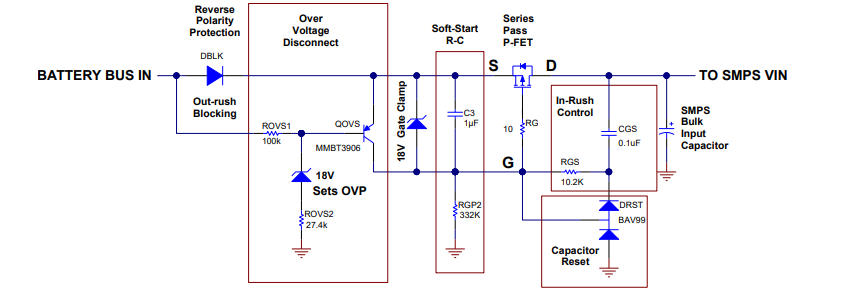
Reference design: Reverse Polarity Protection and Overvoltage Disconnect by Texas Instruments.
This type of circuit is widely used in modern vehicles including petrol, diesel, hybrid, and electric cars such as Toyota and Tesla. Reverse polarity protection is essential in systems like ECUs, lighting modules, DC-DC converters, and sensors.
In this design, an ultrafast silicon diode is used because it offers high reverse voltage tolerance and robustness against automotive transients. Silicon diodes are preferred over Schottky diodes in automotive applications due to their ability to handle high voltage and harsh environments, even though they have a slightly higher forward voltage drop.
2. Industrial Automation Sensors

The Omron E3Z Photoelectric Sensor is commonly used in industrial automation systems such as conveyor belts, robotics, and packaging systems. It includes internal reverse polarity protection to ensure reliable operation even under incorrect wiring.
Silicon diodes are commonly used in these sensors due to their reliability, low cost, and good thermal stability. In some cases, Schottky diodes may be used for lower voltage drop and improved efficiency, but silicon diodes are preferred in rugged environments for their durability and high reverse voltage capability.
3. My Application
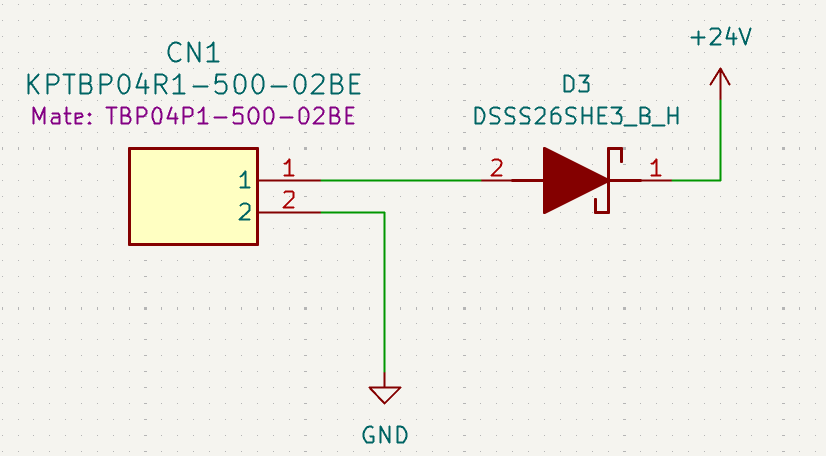
I have used Schottky Diodes (SS26SHE3_B/H, 60V, SMA package) to protect my system from external power sources. These diodes provide efficient reverse polarity protection with low forward voltage drop, making them suitable for my design.
Conclusion
All electronic systems must include protection against electrical overstress. Reverse polarity protection is a simple and essential design practice that improves reliability and prevents damage. It should always be included in any PCB or electronic system design.